Early-retirement tax planning
See what your income does to your ACA subsidy — before you retire before 65.
Medicare starts at 65. Retire before that and you buy your own coverage on the marketplace for the gap — where every dollar of income moves your premium subsidy. GlidePath maps that bridge year by year on the real IRS sliding scale, from the same retirement plan that sizes your Roth-conversion window — on your own machine, no account, no advisor portal.
The years between retiring and Medicare are a blind spot in most plans.
Retire at 60 and you have a five-year bridge to cover yourself — and on the marketplace, what you pay is set by your MAGI (the modified adjusted gross income the subsidy is measured against). The same withdrawals and Roth conversions that make a low-tax year so valuable also push that income up.
That trade-off usually lives in an advisor’s spreadsheet, or a planning suite you feed your balances into. GlidePath is a desktop-license app that does the same solve on your own computer, from the retirement plan you already built — so the cost of coverage before 65 isn’t the surprise that wrecks an otherwise solid plan.
What it works out — and where it draws the line.
The subsidy on the real sliding scale
The marketplace doesn’t use one flat rate. The share of income you’re expected to pay toward the benchmark plan — the applicable percentage — rises with your income as a share of the poverty level, in statutory steps. GlidePath works the credit on that actual scale, year by year, and counts 100% of Social Security toward the MAGI (the marketplace rule), so the estimate matches how the credit is really figured — not a rule of thumb.
2026 rules vs. the enhanced rules — your call
The enhanced credits that ran 2021–2025 are scheduled to revert, bringing back the hard 400%-of-poverty cliff and a higher expected contribution — but it’s still being debated. Rather than bake in a guess, GlidePath lets you switch between the two rule sets and see the difference for your own plan, so the picture holds whatever the final rules turn out to be.
The cliff, flagged before you hit it
Past 400% of the poverty level, the credit cuts off entirely — one extra dollar of MAGI can cost the whole subsidy for the year. GlidePath flags how close a withdrawal or a Roth conversion puts you to that edge, marks the years you’d cross it, and — as each spouse turns 65 and moves to Medicare — prorates the premium so a one-spouse bridge year doesn’t overstate the cost.
The pre-65 bridge in your plan: total out-of-pocket, the premium tax credits that offset it, the average per year, and the years your income crosses the subsidy cliff — above a year-by-year table of MAGI, benchmark premium, your share, and subsidy. (Shown with a fictional demo household.)
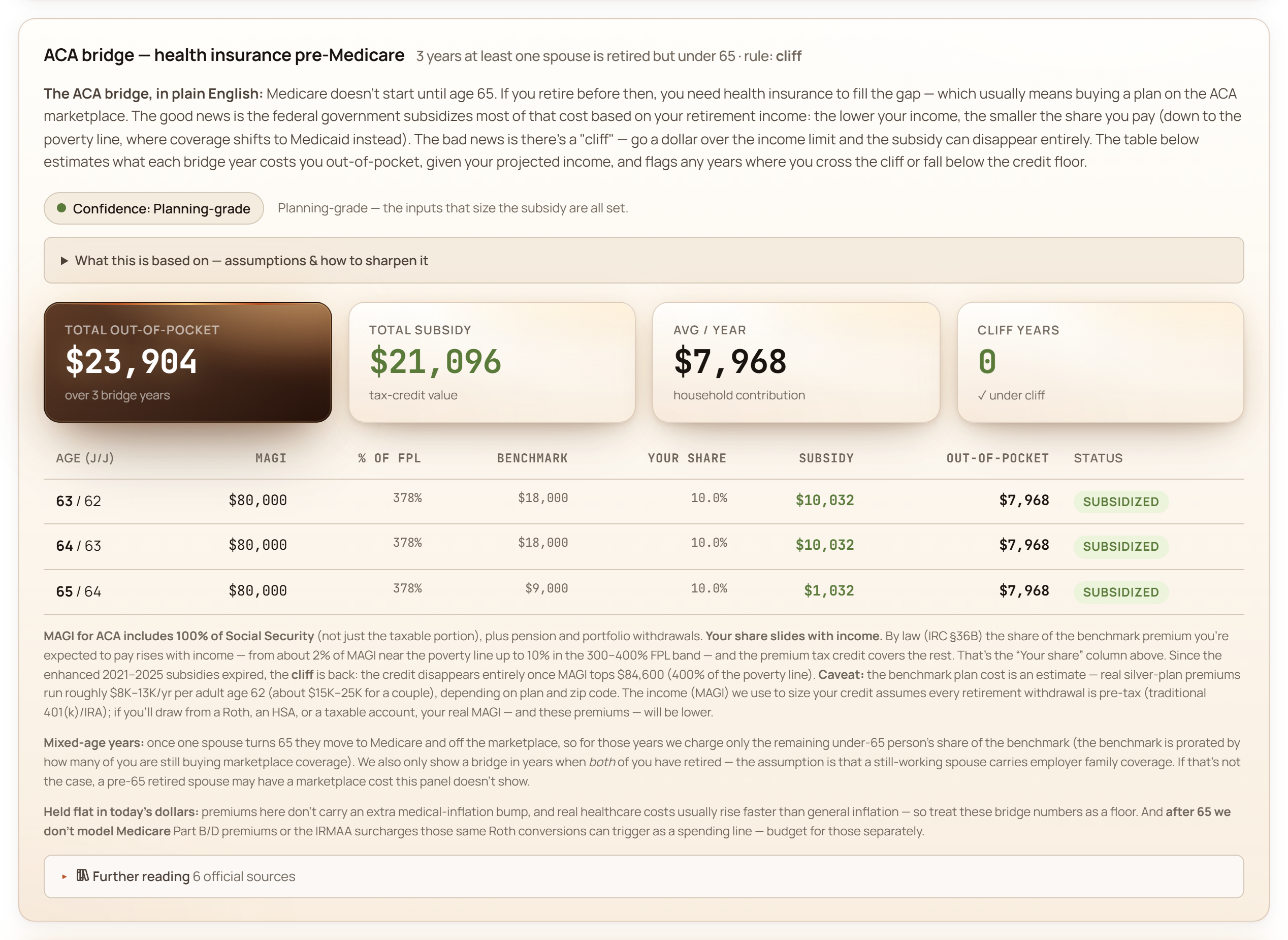
One income picture: your ACA subsidy and your Roth conversions read from the same numbers.
Your spending, pensions, and Social Security timing drive a single MAGI for each bridge year. That one number sizes both the ACA subsidy on this page and the Roth-conversion headroom on the Tax Valley page — so you can weigh them together instead of in two separate tools.
It shows you the trade-off and leaves the decision to you: a bigger conversion fills more low-bracket room now, and the same dollars raise this year’s premium or edge you toward the cliff. GlidePath puts both numbers in front of you from one plan — it doesn’t quietly shrink your conversion room to protect the subsidy, and it won’t pretend there’s one right answer.
It estimates the subsidy — it doesn’t enroll you or file anything.
A bridge plan is only as good as its inputs, and GlidePath is honest about what it carries and what it leaves to you.
The benchmark silver-plan premium is a number you enter for your area (a 2-adult plan near 62 often runs $15K–$25K a year); the MAGI assumes traditional, pre-tax withdrawals, so drawing from a Roth, HSA, or taxable account would lower it; premiums are held flat in today’s dollars, so treat them as a floor; and it models the federal marketplace, not state-specific subsidies. After 65 it’s Medicare, not the marketplace — where the same conversions can trigger IRMAA, modeled on the Tax Valley page. A built-in confidence read tells you whether the estimate is rough, better, or planning-grade based on which inputs you’ve set, and lists its assumptions in plain English. It calculates and organizes; you and the marketplace — or a CPA — confirm.
Common questions
How do Roth conversions affect my ACA subsidy?
They read from the same income. A Roth conversion adds to your MAGI for that year, which can raise the share of the premium you’re expected to pay or, past the 400%-of-poverty cliff, end the subsidy for the year. GlidePath models your ACA subsidy and your Roth-conversion window from the same plan, so you can see both numbers together and decide. It shows the trade-off — it doesn’t automatically shrink your conversion room.
Will I lose my ACA subsidy if I retire before 65?
Not necessarily — it depends on your income. Between retiring and Medicare at 65 you buy marketplace coverage, and the subsidy slides with your MAGI as a share of the federal poverty level. GlidePath estimates your subsidy for each pre-65 bridge year from your own spending, pensions, and Social Security, and flags the years your income would cross the cliff.
What happens to ACA subsidies in 2026?
The enhanced premium tax credits that ran 2021–2025 are scheduled to revert, which brings back the hard 400%-of-poverty subsidy cliff and raises the share of income households pay toward the benchmark plan — but the rules are still being debated in Congress. GlidePath lets you model it either way: switch between the enhanced rules and the reverted rules and see the difference for your own plan, so the picture holds whatever the final rules are.
What is the ACA subsidy cliff?
Under the reverted 2026 rules, the premium tax credit cuts off above 400% of the federal poverty level — so a single extra dollar of MAGI over that line can cost your entire subsidy for the year. GlidePath flags how close a withdrawal or Roth conversion puts you to that edge.
Does GlidePath Money upload my income to estimate the subsidy?
No. The whole estimate runs on your own machine from a plain file you own. There’s no account to log into and nothing is uploaded — the ACA bridge is computed locally, the same as the rest of your plan.
Model the bridge without handing over your income.
$129 desktop license for Personal — the ACA bridge is part of the core retirement planner. Your plan stays in a plain file on your own computer.
GlidePath calculates and organizes the numbers — it isn’t tax or health-insurance advice. ACA premiums, subsidies, and the rules behind them depend on your full situation, your plan and ZIP, and law that can change; confirm your coverage and costs with the Health Insurance Marketplace, and your conversion timing with a CPA, before you rely on them.